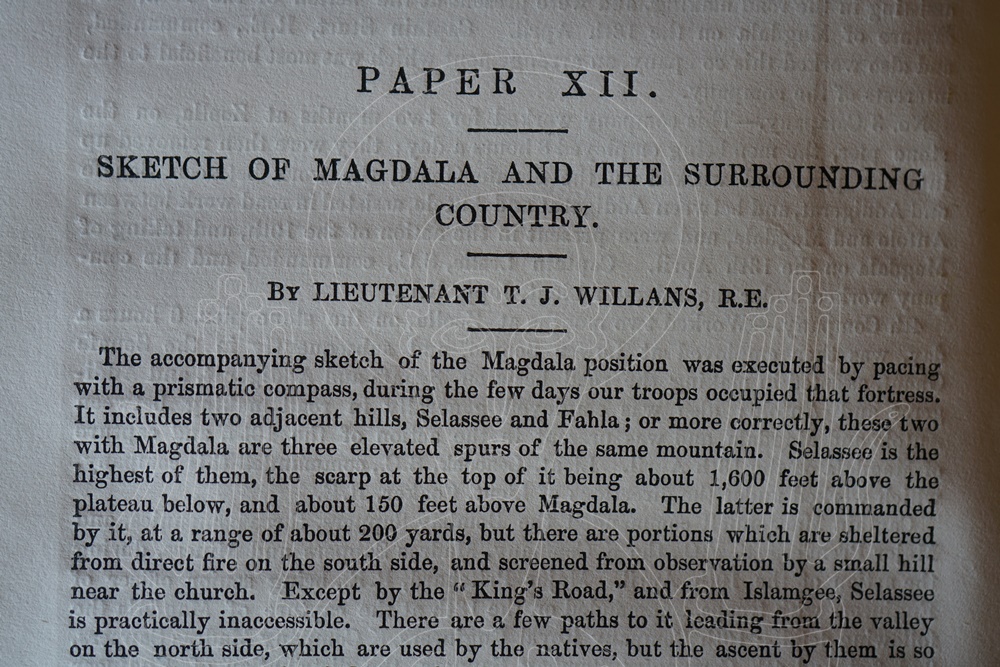
Sketch of Magdala and the surrounding country.
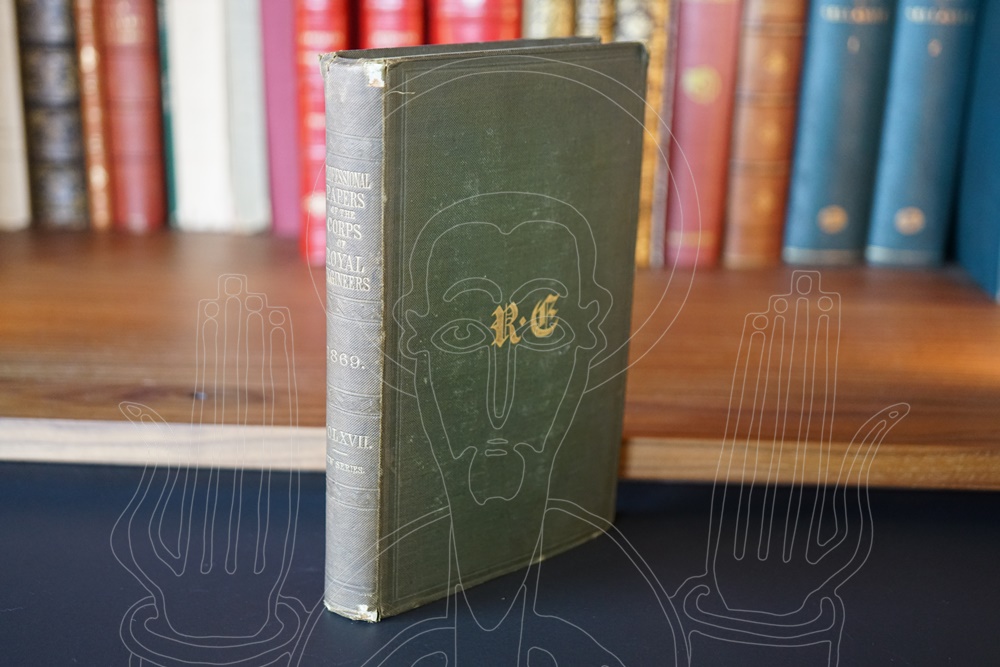
Édition
Éditeur : Jackson & Son
Lieu : Woolwich
Année : 1869
Langue : anglais
Description
État du document : bon
Références
Réf. Biblethiophile : 004607
Réf. Pankhurst Partie : -
Réf. Pankhurst Page : -
Réf. UGS : 0186710
Première entrée : 1867
Sortie définitive : 1868
COLLATION :
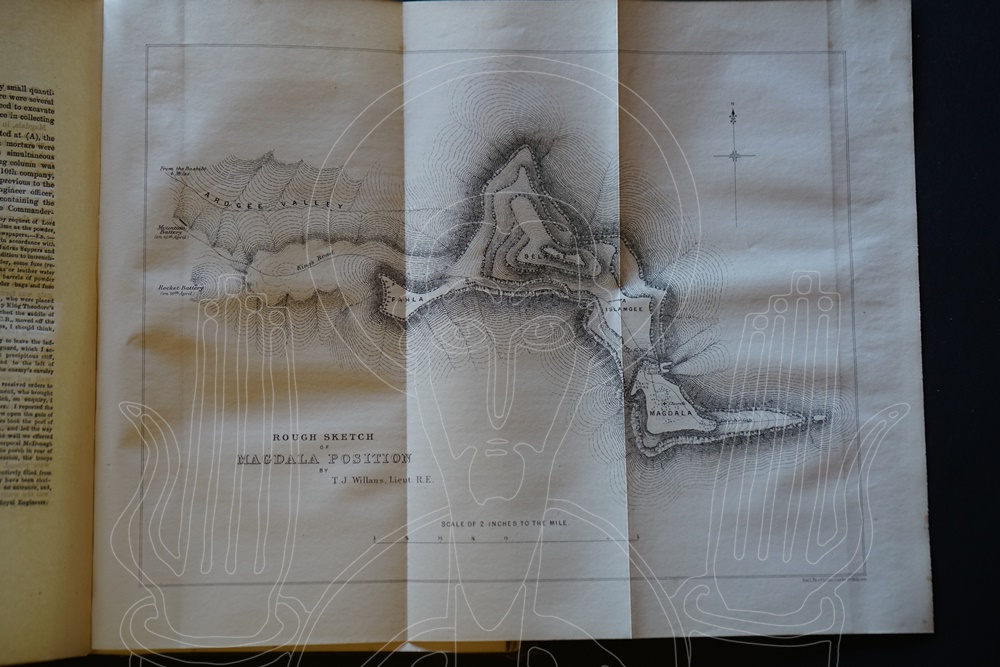
in "Papers on subject connected with the duties of the Corps of Royal Engineers", new series, vol. XVII, 207 p., 42 illustrations., pp. 150-153, avec une planche dépliante s'y rapportant.
En savoir plus
À partir du 16 novembre 1867, le lieutenant T. J. Willans R.E. supervise la construction du chemin de fer qui relie Zoolla à Koomaylee. Le 15 mars 1868, il est appelé au front pour être de retour à Zoolla le 20 mai[1].
Dans Sketch of Magdala and the surrounding country, Willans décrit la position de Magdala, la représente au moyen d’un plan à l’échelle et rend compte de l’assaut de l’amba du 13 avril 1868. Son témoignage, concis, se démarque des récits surréalistes, autant contemporains des événements que modernes. Il relativise l’efficacité des tirs du canon Armstrong, des roquettes et des mortiers. Le succès de l’opération tient plus aux hommes et à leur nouveau fusil[2] qu’à l’armement lourd. Après une demi-heure d’un feu nourri de l’artillerie en direction de la porte de Kokilbir, le 33rd Duke of Wellington’s Regiment et une partie de la 10e compagnie, Royal Engineers, commandée par le major Gordon Pritchard forcent le passage.
La présence de Willans devant Kokilbir n’est pas confirmée dans le texte contrairement à Walter Andrew Wynter par exemple qui témoigne de l’incident des explosifs. D’après Wynter, c’est seulement devant la porte que Pritchard et son détachement se rendent compte qu’ils ont oublié les explosifs[3]. Willans reporte la responsabilité sur le commandant en chef, Sir Robert Napier. Le capitaine Goodfellow l’aurait averti que les barils de poudre étaient arrivés mais sans les powder bags. Napier aurait, malgré tout, décidé de lancer l’assaut.
Après les combats, Napier demande que rapport soit rendu sur l’incident. Pritchard s’exécute dans un mémorandum relayé par Willans:
Mémorandum
About 8.30 on the morning of Monday, the 13th April, 1868, in accordance with orders received, the 10th Company of Royal Engineers, and one company of the Madras Sappers and Miners, marched from their camp on the Affigi plateau towards Magdala. In addition to intrenching tools, they took with them two escalading ladders, two small barrels of powder, some fuze (resembling that of Bickford’s), and six powder bags made from the native mussocks or leather water bags. According to the orders of Captain Goodfellow, Royal Engineers, the two barrels of powder were placed on a mule, one on each side of an Otago pack-saddle, with the powder bags and fuze between them.
The above force (joined by two companies of the Bombay Sappers and Miners, who were placed under my command for the day by Captain Goodfellow, R.E.), advanced at 9 a.m. up King Theodore’s road, in rear of two companies of the 33rd Regiment. When they had nearly reached the saddle of land joining Selassee and Fahla, they, by orders received from Sir C. Staveley, K.C.B., moved off the road to the left, directly under the high cliff bounding Selassee and about two miles, I should think, from our camp on the Affigi plateau.
Before ascending the crevice in this cliff, I received orders from Sir C. Stavely to leave the ladders, powder barrels, bags, &c, at the foot, and to move forward as an advance guard, which I accordingly did. We went up the crevice and climbed up the steep and almost precipitous cliff, inaccessible to horses or mules, passed through the enemy’s camp, marched round to the left of Selassee, and approached Magdala in skirmishing order, there being several of the enemy’s cavalry riding about in front of the gateway.
About 2 p.m., when it was decided that Magdala should be taken by assault, I received orders to send back for the ladders, powder barrels, bags, &c. I accordingly sent a detachment, who brought up the ladders, the two barrels of powder, and fuze, but not the powder bags, which, on enquiry, I found had been taken by the natives for their original purpose of carrying water. I reported the circumstance to Sir C. Staveley, and informed him that I could, if necessary, blow open the gate of Magdala with one of my barrels of powder and fuze. About 4 p.m., the Engineers took the post of honour, carrying our intrenching tools, ladders, two barrels of powder, fuze, &c., and led the way along a path on the side of a precipice to the gate, on the right of which, over the wall we effected an entrance by climbing and using our ladders. On our entrance, I told off Lance Corporal McDonagh to assist in removing the huge blocks of stone which had completely blocked up the porch in rear of the gateway. Had I attempted to blow open the gate with the powder in my possession, the troops who forced their way up in rear of us would have been blown over the precipice.
The gate was at the entrance of a porch 15 feet square, and this porch was entirely filled from immediately behind the gate with huge blocks of stone, so that the gate would only have been shattered by the powder, the stones behind it remaining as an impenetrable obstacle to an entrance, and, therefore, the application of powder would have been utterly useless.
G. D. Pritchard, Major, Royal Engineers.
Alors oubli ou vol des sacs à poudre ? Après un siècle et demi, la question est toujours ouverte. En attendant, le soit disant oubli fait les choux gras de la presse et probablement coûte à Pritchard son C.B.
Biblethiophile, 08.02.2026
[1] WILKINS ([Henry] S[ain]t Clair), Abyssinian expedition. Report from Lieut.-Colonel St. Clair Wilkins, R.E. […] to Captain T. S. Holland […], p. 143.
[2] C’est à Magdala que le Snider est utilisé pour la première fois au combat, Snider–Enfield, Wikipedia, consulté le 29.01.2026.
[3] WEBB-CARTER (B. W.), « A Subaltern in Abyssinia », Journal of the Society for Army Historical Research, Volume XXXVIII, No 156, December 1960, p. 149.